Atlanta Relocation Guide for Retirees
Real Estate June 2, 2026
Real Estate June 2, 2026
One of the questions I get most often from relocation buyers is:
“Which county has the lowest property taxes for retirees?”
The answer is a little more nuanced than most people realize.
Recently, I spent some time comparing senior property tax exemptions across Fulton, DeKalb, and Cobb Counties. While lifestyle, location, proximity to family, healthcare, and amenities should always be part of the conversation, property taxes can have a meaningful impact on your long-term cost of ownership—especially during retirement.
If you’re relocating to Atlanta from another state, here’s what you need to know.
The Quick Summary
Cobb County
Affluent retirees
School tax exemption beginning at age 62
Some exemptions have residency requirements
Fulton County
Long-term homeowners in Sandy Springs, Milton, Alpharetta, Johns Creek
New 2026 senior exemptions can be substantial
Many benefits require prior Fulton homestead history
DeKalb County
Moderate-income retirees
Strong exemptions if income qualifies
Most valuable exemptions are income-restricted
The Sleeper: Cobb County
Cobb County is often overlooked by relocation buyers, but it may be the most tax-friendly option for retirees.
For homeowners age 62 and older, Cobb offers school tax exemptions that can significantly reduce annual property taxes. In many cases, this exemption removes what is often the largest portion of the tax bill.
For retirees purchasing in communities such as:
Historic Marietta
East Cobb
Smyrna
Vinings
Cobb County frequently produces the lowest long-term property tax burden among Atlanta’s major suburban counties.
The lifestyle is often surprisingly appealing as well. Historic Marietta offers a vibrant town square, restaurants, concerts, farmers markets, and a true sense of community. Vinings and Smyrna provide quick access to both Buckhead and Midtown while maintaining a more suburban feel.
As an example, I had dinner in Historic Marietta recently and the drive from my home in Dunwoody took only about 28 minutes on a Saturday evening.
For many retirees relocating from the Northeast, Cobb deserves a serious look.
Fulton County: Attractive, But With a Catch
Fulton County became significantly more attractive in 2026 thanks to new senior tax exemptions.
The current exemptions include:
On paper, these are excellent benefits.
However, there’s an important detail many relocation buyers miss.
To receive the most valuable exemptions, homeowners generally must have maintained a Fulton County Schools homestead exemption for five of the previous six years.
In practical terms, someone moving from Connecticut to:
Sandy Springs
Milton
Alpharetta
Johns Creek
would not immediately qualify for the enhanced benefit.
This makes Fulton particularly advantageous for long-term residents who are already established within the county, but less impactful for newcomers during their early years of ownership.
That said, Fulton remains one of the most desirable places to live in Metro Atlanta because of its exceptional housing stock, healthcare access, parks, restaurants, and overall quality of life.
DeKalb County: Often Misunderstood
DeKalb County includes highly desirable communities such as:
Dunwoody
Brookhaven
Chamblee
Decatur
Many people assume DeKalb offers the best senior tax exemptions, but the reality depends heavily on income.
DeKalb does provide several excellent senior exemptions, including school tax relief and enhanced homestead programs. However, many of the most valuable benefits are income-based.
For example, the highly sought-after H9 exemption:
The challenge is that many executive-level retirees exceed the income thresholds.
Typical relocation buyers often have:
IRA distributions
Pension income
Investment income
Social Security benefits
Capital gains
As a result, many affluent retirees do not qualify for DeKalb’s largest tax-saving programs.
Unlike Fulton, DeKalb generally does not require years of prior residency. Once you establish your primary residence and homestead exemption, you can typically apply immediately if you meet the age and income requirements.
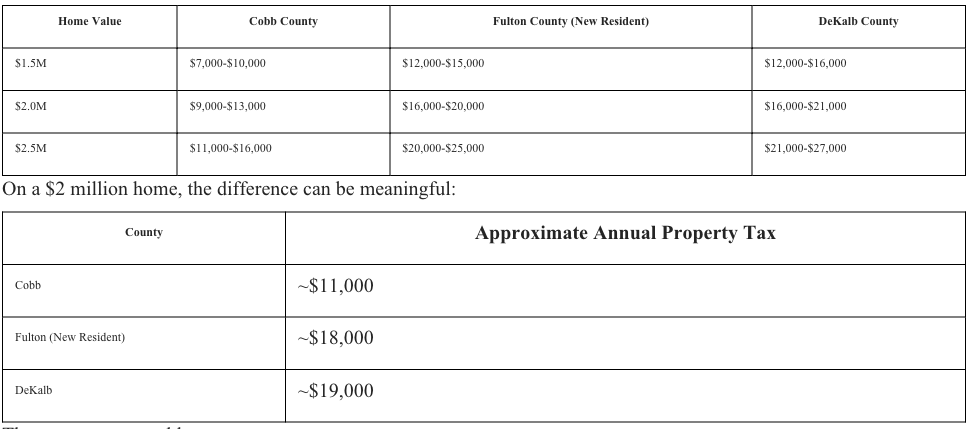
What This Means in Real Dollars
Assuming:
Estimated annual property taxes may look something like this:
That represents roughly:
$7,000-$8,000 per year in savings
$70,000-$80,000 over a 10-year retirement
So Which County Is Best?
The answer depends on your priorities.
If your goal is minimizing long-term property taxes and you’re age 62 or older, Cobb County is often the clear winner.
If your priority is access to communities like Milton, Alpharetta, Johns Creek, or Sandy Springs, Fulton may still be worth the premium despite the delayed tax benefits.
If you love Dunwoody, Brookhaven, or Decatur and your retirement income falls within qualifying ranges, DeKalb can offer meaningful savings as well.
My Advice to Relocation Buyers
Taxes are important, but they should never be the only factor.
When helping clients relocate to Atlanta, I always encourage them to think about:
Sometimes the “best” tax situation isn’t the best life situation.
My role isn’t to tell you where to live. It’s to make sure you understand all of the variables so you can make the most informed decision possible.
And occasionally, that means throwing a little curveball into the conversation and suggesting an area you may not have considered.
You might be surprised by what you discover.
Stay up to date on the latest real estate trends.


Brandon's goal isn’t just to help you buy or sell a house — it’s to guide you through a meaningful life transition with honesty, empathy, and precision. Whether it’s negotiating the best outcome, refining a property’s presentation, or simply listening deeply, his focus is always the same: your success and peace of mind.