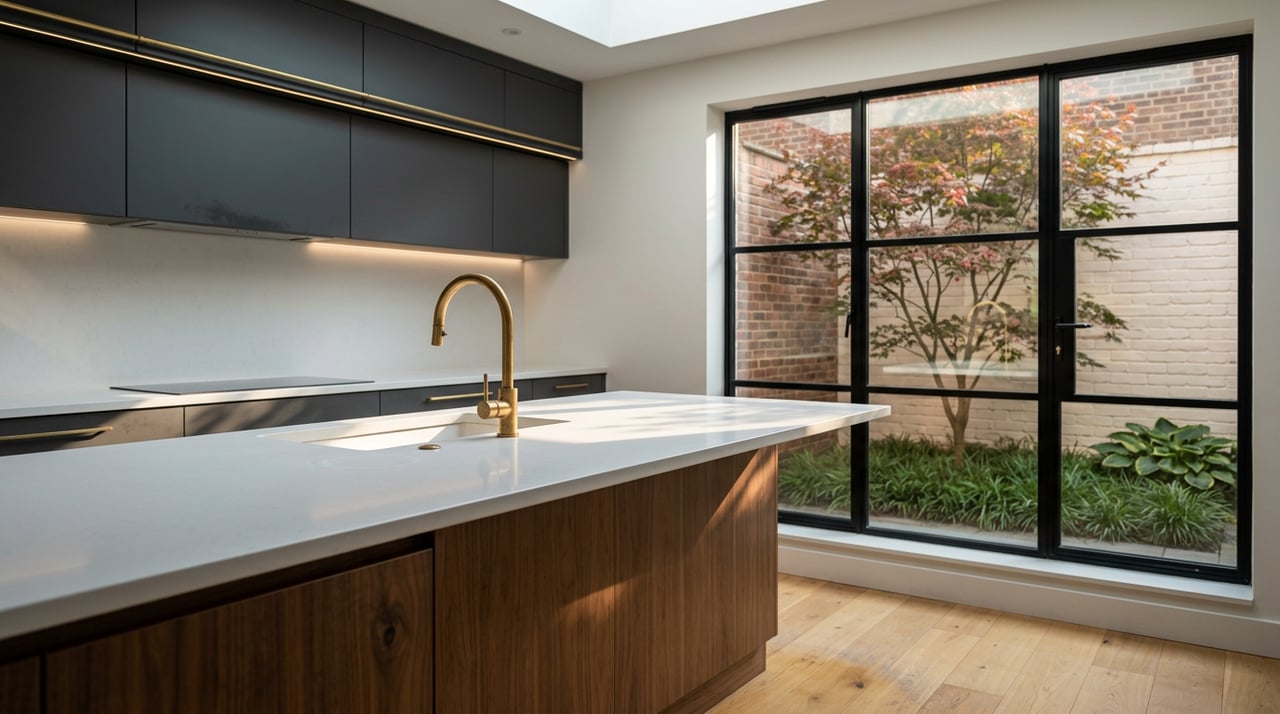
West Midtown Stopped Being a Test Kitchen
August 13, 2026
August 13, 2026
For a decade, West Midtown worked because it was cheap to fail in. Warehouse rents let a chef try an idea, see if Atlanta wanted it, and close quietly if the answer was no. That was the deal: raw ceilings, roll-up doors, low overhead, high churn. You could feel it walking down Howell Mill on any given Friday. Something new, something gone, something else moving into the space that used to be the something else.
That deal has been changing for about a year now, and the evidence is not another opening announcement. It is who is opening, and what they are willing to spend to stay.
Star Metals did not fill its ground floor with concepts hoping to get noticed. It filled it with operators who already had the notice.
Füm opened in February 2026 inside the new Stella at Star Metals tower, and it is not a satellite location testing the market. According to the AJC's coverage, it is Miami-based Grassfed Culture Hospitality's largest and most ambitious restaurant to date, brought here by creative director Pili Restrepo, executive chef Sebastián Vargas, and CEO Josh Hackler. A group with a proven Miami audience chose to make its biggest bet in West Midtown, not in Buckhead or Midtown proper.
A few doors down, Ghee Indian Kitchen marks chef Niven Patel and restaurateur Mo Alkassar's first Atlanta restaurant. Both are James Beard semifinalists, and the menu pairs Georgia-sourced produce with a 13-dish tasting format alongside a la carte options and Indian wines. That is not a soft launch. That is two operators with national reputations deciding West Midtown was the market worth entering first.
Neither restaurant needed to open here. Both did.
The pattern holds at a smaller scale too. Avize, the modern European room under chef Karl Gorline and sommelier Taurean Philpott, sources hyper-seasonal produce from a partner farm in Bremen, Georgia, and arrived already carrying a Michelin recommendation, an Eater Atlanta Best New Restaurant nod, and a James Beard semifinalist mention. That is a restaurant that built its credibility before it built its dining room, then chose West Midtown as the place to spend it.
Barrel Proof, the whiskey bar that landed on Howell Mill with hundreds of bottles on the menu and dark corner tables built for slow sipping, is a smaller bet by dollar amount but the same signal by intent. It is not a pop-up hedging against foot traffic. It is a room designed for people who already planned to be there.
Here is the detail that made the pattern impossible to ignore. Monday Night Brewing did not add a second West Midtown location. It retired its original taproom, the one with the necktie wall that put the brand on the map, and opened a new concept called The Grove just 90 feet away, built to sit directly on a stretch of Beltline trail its old building never touched.
Think about what that decision actually costs. Monday Night could have kept running the original space as-is and called any expansion elsewhere growth enough. Instead it walked away from the building that made the brand, to build 17,000 square feet of amphitheater-style outdoor space, complete with fire pits, communal tables, twin pizza ovens, and a 20-foot outdoor screen, positioned to catch trail traffic the old taproom never had. That is not a business hedging its bet on a neighborhood. That is a business paying to move ninety feet because those ninety feet now matter more than the address it already had.
Dr. Scofflaw's, running as Scofflaw Brewing's dedicated research and development brewery inside The Works development with 76 taps of its own, has made a quieter version of the same choice: keep investing in West Midtown rather than expand out of it. Two of the neighborhood's original craft breweries, in other words, both bet on staying.
None of this happened in isolation from what has been under construction along the Beltline itself. Trail work through the Westside corridor picked up earlier this year, with permanent lighting and camera upgrades along the original Westside Trail completed by April 2026, timed so the corridor was ready before this year's FIFA World Cup matches came through Atlanta Stadium in June and July. Restaurant groups and brewers do not usually place multi-million dollar bets ahead of infrastructure they are not confident about. The fact that Monday Night rebuilt toward the trail months before that tournament arrived suggests the neighborhood's foot traffic was already trending up on its own, tournament or not.
Taken one at a time, each of these reads like a normal restaurant opening. Taken together, they describe a neighborhood where the people who know these businesses best, the operators themselves, are betting on permanence rather than churn.
If you have lived here a while, you already know West Midtown rewards a certain kind of evening: park once, walk between two or three spots, end up somewhere you did not plan to be. That habit still works. What is different is that the places you stumble into now are more likely to still be there in three years, run by people who chose this neighborhood on purpose rather than as a cheaper alternative to somewhere else.
That is worth knowing the next time you are deciding where to walk after dinner. The neighborhood is not auditioning anymore. It is placing bets it intends to keep.
If you are weighing what a home in this corridor is actually worth given how the neighborhood keeps building on itself, Brandon Patterson works this market daily and can talk through what that means for your specific street. Request a private consultation whenever you are ready to have that conversation.
Stay up to date on the latest real estate trends.
Brandon's goal isn’t just to help you buy or sell a house — it’s to guide you through a meaningful life transition with honesty, empathy, and precision. Whether it’s negotiating the best outcome, refining a property’s presentation, or simply listening deeply, his focus is always the same: your success and peace of mind.